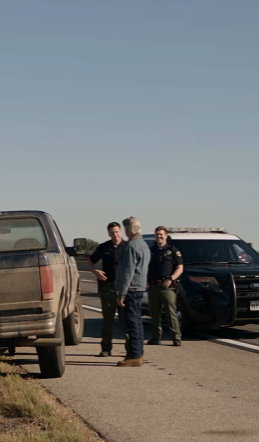
A Retired State Investigator Was On His Way To Visit His Daughter
Chapter 1
A Retired State Investigator Was On His Way To Visit His Daughter
A RETIRED STATE INVESTIGATOR WAS ON HIS WAY TO VISIT HIS DAUGHTER WHEN TWO LOCAL COPS PULLED HIM OVER ON INTERSTATE 70, TOOK HIS WALLET FROM HIS POCKET, LAUGHED AT THE BADGE THEY DIDN’T RECOGNIZE, POCKETED $1,000, AND TOSSED HIS WALLET ONTO THE PAVEMENT—BUT THE OLD MAN NEVER ONCE RAISED HIS VOICE, AND THE NAME HE QUIETLY MENTIONED DURING ONE PHONE CALL CHANGED WHAT EVERYTHING MEANT
Elias Vance had been driving along Interstate 70 for almost three hours when flashing lights suddenly appeared in his rearview mirror.
He exhaled, glanced at his speed, and eased his worn pickup onto the shoulder.
He wasn’t rushing.
His daughter had already sent him two texts that morning.
*Take your time, Dad. Dinner can wait.*
At sixty-eight, Elias had learned that there were very few things in life worth hurrying for.
The police cruiser pulled in behind him.
Two officers stepped out.
Elias watched their approach in the side mirror.
One had dark hair and looked to be somewhere in his late thirties. The other was younger, heavier-built, and followed several steps behind.
Elias rolled down his window.
“Good afternoon, Officer.”
The dark-haired officer gave no reply.
“Get out.”
Elias studied him briefly, then calmly opened the door.
Years ago, he probably would have immediately asked why he was being stopped.
Today, he simply stepped out onto the pavement.
The officer came unusually close.
His nameplate said **KELLER**.
The second cop, Pike, remained closer to the cruiser, watching.
“What appears to be the problem?” Elias asked.
Keller looked him over from head to toe.
Faded denim jacket.
Work boots.
Gray hair.
An aging pickup that had survived better decades.
Apparently, that was all Keller needed.
Without any warning, Keller reached toward the pocket of Elias’s pants.
Elias’s expression shifted almost imperceptibly.
It wasn’t fear.
It was recognition.
He knew precisely what kind of boundary had just been crossed.
Keller pulled Elias’s wallet from his pocket and flipped it open.
Then he paused.
Inside sat an old law-enforcement badge.
It didn’t belong to the local police department.
It wasn’t even from that region of Ohio.
Keller held it up between two fingers and gave Elias a crooked grin.
“Who’d you steal this badge from, old man?”
Several feet away, Pike smirked.
Elias made no move to take the badge back.
He didn’t raise his voice.
“It belongs to me.”
Keller stared at him another moment.
Then he laughed.
He turned his attention back to the wallet.
That was when he noticed the money.
Elias had taken out cash before leaving home because his daughter was having repairs done to her house, and he’d promised to help cover the contractor’s bill.
Keller removed the bills.
He counted them quickly.
Then he pulled aside ten hundred-dollar bills.
One thousand dollars.
Elias watched as Keller folded the cash once and slipped it into his own shirt pocket.
Still, Elias said nothing.
Pike remained silent too.
For several seconds, the only sounds came from cars speeding by and the cruiser’s engine idling behind them.
Then Keller placed Elias’s badge back inside the wallet.
He looked straight at the older man.
There was no uncertainty in his expression.
No worry.
No indication that he believed anyone could stop him.
Keller tossed the wallet onto the asphalt beside Elias’s boots.
“Move along, old man. Consider the theft forgotten.”
Then he turned away.
Pike followed him back toward the patrol car.
Neither man bothered to look behind them.
Elias stared down at the wallet resting on the pavement.
He could see the edge of his badge peeking from inside.
For over thirty years, that badge—or badges much like it—had opened doors, settled disputes, and reminded younger officers that authority came with responsibility.
Today, it had been handled as though it were something stolen from a costume store.
But the badge wasn’t what troubled Elias the most.
Neither was the money.
There had been something about Keller’s confidence that bothered him from the instant the officer climbed out of the cruiser.
People didn’t act that comfortably unless they were convinced someone was protecting them.
Elias slowly reached into his other pocket.
He took out his phone.
The two officers were almost back at their cruiser when Elias raised it to his ear.
A man picked up on the second ring.
Elias kept his gaze fixed on Keller and Pike.
His voice stayed quiet.
“It’s me. Mercer still running these two?”
Silence followed from the other end.
Then the man’s tone changed entirely.
“Elias… exactly where are you?”
Elias glanced toward the mile marker beside the highway shoulder.
And for the first time since the traffic stop began, he almost smiled.
PART 2: The Storage Failure
The phone rang four times before a gruff, familiar voice answered on the other end. I hadn’t spoken to Marcus in years, but when you spend two decades dismantling corrupt task forces together, you don’t need small talk.
PREVIOUSLY
I was driving to my daughter Sarah’s new house when two local cops pulled me over on an empty stretch of Interstate 70. Officer Keller didn’t ask for my license. Instead, he dug into my wallet, pocketed the thousand-dollar cash gift I’d just withdrawn for Sarah’s broken water heater, and claimed civil asset forfeiture. He laughed at my retired investigator shield and threw my wallet on the asphalt, leaving behind the one thing he shouldn’t have: the bank’s stamped withdrawal slip.
CHAPTER 2: The Blue Wall
“Marcus,” I said, keeping my voice level as the highway traffic hummed past my rolled-up window. “I need a quiet favor.”
“Elias,” Marcus said. The surprise in his voice lasted only a second before the old professional rhythm took over. He was a Deputy Director with the State Police now, sitting behind a desk in the capital, but he still sounded like the street detective I used to share terrible diner coffee with at two in the morning. “It’s been a while. You sound like you’re standing on the edge of a cliff. What’s wrong?”
“I was just stopped on Interstate 70, westbound. Mile marker eighty-two.” I looked down at the withdrawal slip in my hand, flattening the creases against my thigh. “A local cruiser. Two officers. The primary had the nameplate Keller. Secondary was Pike. They performed a warrantless search of my person, bypassed my identification, and removed one thousand dollars in cash from my wallet under the guise of civil asset forfeiture. No receipt issued. No paperwork filed.”
The line went dead silent. I could hear the faint clicking of a keyboard in the background.
“Mile marker eighty-two,” Marcus finally said, his tone shifting into something hard and cold. “That’s Oakhaven Township jurisdiction. It’s a two-mile sliver of highway that cuts through their county lines. They write more tickets in that two-mile stretch than the rest of the county combined.”
“They aren’t just writing tickets, Marcus.”
“I can have an internal affairs squad car down there in forty-five minutes, Elias. We’ll pull them off the road right now.”
“No,” I said immediately. “If you send State Police rolling in loud, that cash disappears into a storm drain before you cross the township line. Keller will say I was speeding, that I became combative, and that he let me off with a warning. There will be no record of the money. It becomes a he-said, she-said against a retired guy in a beat-up truck.”
“So what do you want to do?”
“Pull Oakhaven’s stop data for the last six months,” I said. “Look for asset seizures under five thousand dollars. Out-of-county plates. Older drivers. People who are unlikely to hire a lawyer to fight for cash that’s already gone.”
“Give me until tomorrow morning,” Marcus said. “Where are you going now?”
“I’m going to see my daughter. I’m already late.”
I ended the call and put the truck in gear. The rest of the drive was quiet. I didn’t turn on the radio. I just listened to the steady hum of the worn tires against the asphalt, turning the situation over in my mind.
When I finally pulled into Sarah’s driveway, the sun was beginning to dip below the tree line. Her house was a small, single-story fixer-upper at the end of a cul-de-sac. She had closed on it three weeks ago, sinking every dime of her savings into the down payment.
She opened the front door before I even reached the porch. She was wearing a heavy wool sweater, a thick scarf, and a pair of fuzzy socks.
“Dad,” she smiled, stepping out to hug me. “You made it. I was starting to worry.”
“Traffic was heavier than expected,” I said, hugging her back.
I stepped inside, and the chill hit me immediately. It was colder inside the house than it was on the porch. Sarah had a small electric space heater running in the living room, glowing a faint, inadequate orange, but the rest of the house felt like a walk-in freezer.
“The plumber came by for an estimate,” Sarah said, rubbing her arms as she led me into the small kitchen. She had a kettle boiling on a hot plate. “The water heater is completely rusted through at the bottom. It’s a total loss. He said he can install a new one on Monday, but…” She trailed off, offering a tight, forced smile. “I might have to put it on the credit card for now. The interest rate is awful, but I can’t live in an igloo.”